
Let me ask you something honestly.
How many workout plans have you started and quietly abandoned somewhere around week two or three? Maybe you downloaded something from a fitness app. Maybe you grabbed a plan off Pinterest. Maybe a friend sent you their routine and you thought, sure, I'll try this.
And it just... didn't stick.
Here's the thing that's not your problem. That's a fit problem. Generic plans are built for nobody in particular, which means they work well for almost nobody. A personalized workout plan is different. It's built around your actual life, your schedule, your body, your goals and yes, even what you actually enjoy doing. Because that last part matters more than most fitness content will ever admit.
This guide walks you through building one from scratch. Not a template. Not a "one size fits most" plan with your name slapped on it. An actual, thoughtful plan that fits you.
Why Generic Plans Keep Failing You
Every fitness coach hears the same question constantly. "What's the best workout plan?"
The honest answer is always the same: the best plan is a personalized one.
Generic plans don't know that your left knee has been weird since that hiking trip two summers ago. They don't know you have 35 minutes on weekday mornings before your kids wake up, not an hour. They don't know you genuinely hate running but would happily cycle for an hour. And they definitely don't know what you're actually trying to accomplish, beyond the vague surface-level goal most people walk in with.
Following a plan that doesn't fit your situation is actually one of the most common reasons people plateau, get minor injuries or just quietly stop showing up. It's not a willpower issue. It's a mismatch. And the solution isn't trying harder with the wrong plan, it's building the right one.
A personalized workout plan removes the guesswork. It gives you something to follow that was designed for your life, not someone else's. And when motivation dips which it will, for everyone, at some point having a plan that fits your reality is what makes the difference between skipping one session and abandoning the whole thing.
Step 1: Honestly Assess Where You Are Right Now
Before you write a single workout, you need to understand your starting point. Most people want to skip this part. They just want to get going. But your assessment is literally what makes everything else in your personalized workout plan work.
Three things to look at honestly.
What Is Your Current Body Composition?
Body composition means your ratio of lean muscle to body fat, not the number on your scale. Two people can weigh exactly the same and need completely different training approaches because their body composition is different.
You don't need a fancy scan. Take a photo of yourself right now or if your gym has an InBody machine, use it. This isn't about judging yourself, it's about giving yourself a real reference point so that when you're six weeks in and feel like nothing's happening, you can look back and actually see the changes your eyes are missing in the mirror every day.
What Are Your Movement Abilities Right Now?
Think back to the last time you were physically active. What movements felt fine? What felt awkward or stiff? Was there anything that caused actual discomfort or pain?
Write this down. Seriously, don't just think about it. Because when you're choosing exercises later, this information is what keeps you from building a plan around movements your body isn't ready for yet.
If you have access to a qualified trainer for even one session, let them assess your movement. One professional eye can catch things that would take you months of trial and error to figure out on your own.
What Is Your Current Fitness Level, Really?
The sweet spot for any plan is something challenging enough to create change, but not so hard you can't recover from it. Too easy, nothing happens. Too hard, you break down faster than you adapt.
Be real with yourself here. If you've been mostly sedentary for the past several months, jumping into four intense gym sessions a week isn't ambitious, it's a setup for injury and burnout. Starting with three manageable sessions and building from there is actually how lasting progress happens. The people who make the best long-term progress are almost always the ones who started more conservatively than they thought they needed to.
Take Stock of Your Practical Resources
This part is just as important as the physical stuff and most guides completely skip it.
How many days a week can you realistically commit not ideally, realistically? How much time do you have per session? What equipment do you actually have access to? Do you prefer going to the gym, working out at home or being outside?
Your personalized workout plan has to fit your actual life. If it doesn't, it won't last past the first major scheduling conflict. And scheduling conflicts happen every single week for most people.
Step 2: Define Your Goals And Then Dig Deeper
Most people stop at the surface goal. Lose weight. Get stronger. Get in shape. Those are fine starting points, but they're not enough to actually drive behavior when things get hard.
The most effective goal-setting process asks why more than once.
If your goal is to lose weight, why does that actually matter to you? Is it to have more energy for your kids? To feel comfortable in your body again after a rough few years? To manage a health issue your doctor flagged at your last checkup? Whatever the real reason is underneath the surface answer, that's the thing that'll actually keep you showing up on a random Thursday when you're tired and you'd rather not.
Use SMART Goals to Make It Concrete
Once you know your real motivation, make it specific. The SMART framework gets used a lot in fitness because it genuinely works. A SMART goal is Specific, Measurable, Achievable, Relevant and Time-Based.
"I want to get stronger" is not a SMART goal. "I want to add 20 pounds to my squat in 12 weeks" is.
"I want to lose weight" is not a SMART goal. "I want to lose 3 pounds of body fat in 8 weeks" is.
See how different those feel? The second version tells you exactly what you're working toward, how you'll measure it and when. That clarity is what makes a personalized workout plan feel purposeful instead of just something you're vaguely doing for your health.
If you're brand new to working out, start with consistency-based goals before outcome-based ones. Something like "I will work out for 30 minutes, 3 days a week, for the next 4 weeks" is a genuinely powerful first goal because it builds the habit that everything else rests on.
What Kind of Goal Are You Working Toward?
Getting Stronger: Resistance training is your main focus, with cardio playing a supporting role. You'll progressively add weight and intensity over time.
Weight Loss: High-intensity cardio combined with resistance training. Both pieces matter here cardio creates a calorie deficit and building muscle raises your resting metabolic rate so you burn more even when you're not working out.
Better Cardiovascular Fitness: Aerobic training takes the lead, with a mix of steady-state and interval work building your engine over time.
Long-Term Health and Longevity: A balanced mix of strength, low-intensity cardio and mobility work. The focus is on staying active and moving well as you age not peak performance, just durable function.
Step 3: Build Your Actual Workout Plan
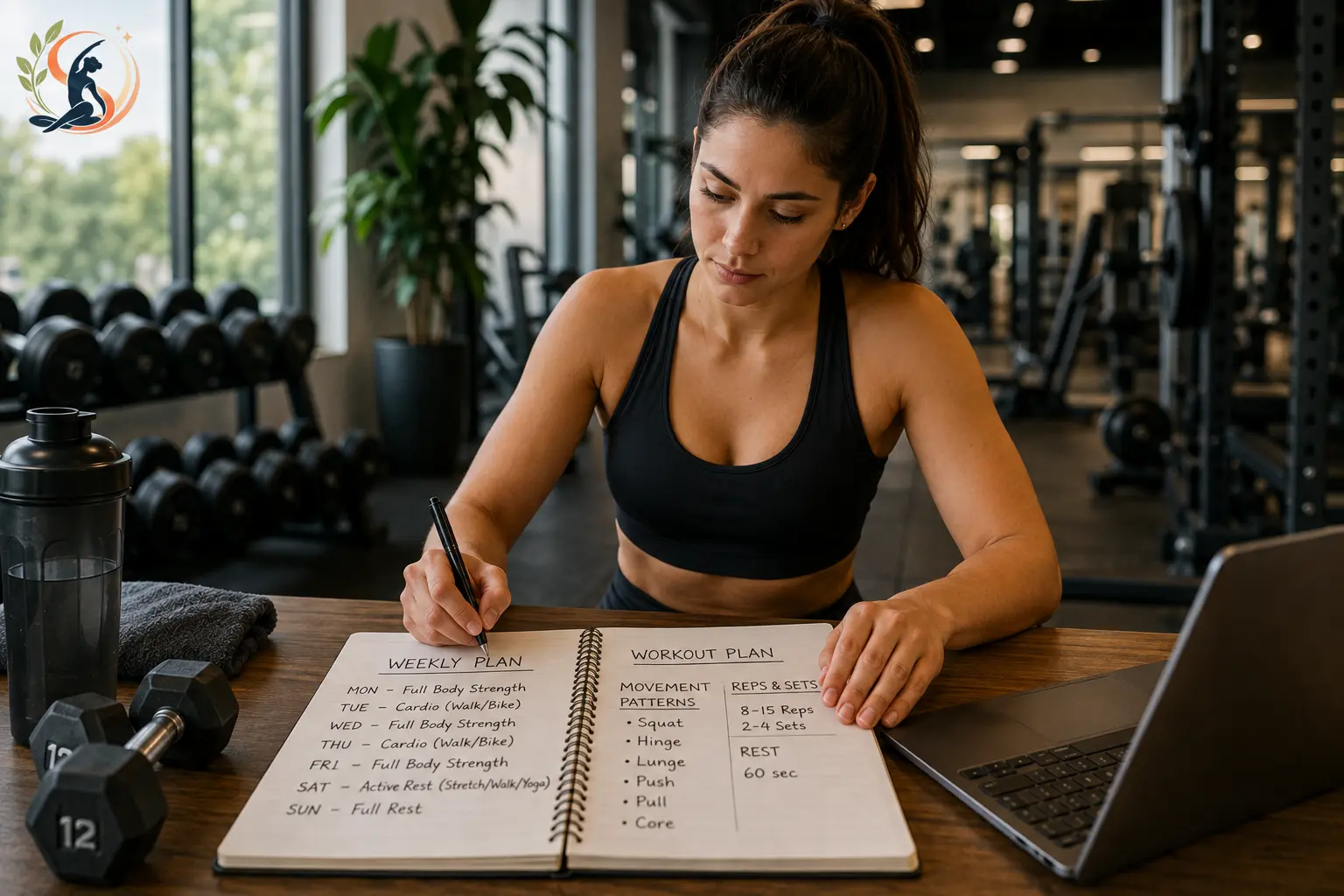
Now you actually get to build it. With your assessment done and your goals clear, you have what you need.
The Foundation: Resistance Training and Cardio Together
A solid personalized workout plan for most goals should include both resistance training and aerobic training. Here's the honest reason why both matter.
Resistance training builds muscle and muscle raises your resting metabolic rate. That means you burn more calories even when you're just sitting around. A strong aerobic system, built through consistent cardio, helps you recover faster between strength sessions and supports your immune system. Together they work better than either does alone and that's not marketing language, it's just physiology.
The Beginner Weekly Split
If you're new to structured training or coming back after a long break, start here and resist the urge to jump ahead.
Exercise 4 to 5 days a week. On 2 to 3 of those days, do full-body resistance training. On the other days, do something aerobic and it genuinely doesn't have to be at a gym. A 30-minute walk, a bike ride, a hike with your dog all of that counts and is honestly some of the most sustainable cardio you can do long-term.
Sample Beginner Weekly Split:
Monday: Full-Body Weight Training
Tuesday: Walk, Hike or Easy Bike Ride
Wednesday: Full-Body Weight Training
Thursday: Walk, Hike or Easy Bike Ride
Friday: Full-Body Weight Training
Saturday: Active Rest (gentle movement stretch, walk or an easy yoga session)
Sunday: Full Rest
Alternate between resistance and aerobic days. Your muscles need recovery time between strength sessions and low-intensity movement on the days in between actually helps that recovery happen faster rather than slowing it down.
The Advanced Weekly Split
If you've been training consistently and can recover well from higher volume, this structure gives you more focused work.
Exercise 4 to 6 days a week. In 2 to 4 days, lift weights split between upper and lower body. On the other days, do cardio and stay active.
Sample Advanced Weekly Split:
Monday: Weight Training Upper Body
Tuesday: Cardio (Rowing, Cycling or Walking)
Wednesday: Weight Training Lower Body
Thursday: Weight Training Upper Body
Friday: Cardio (Rowing, Cycling or Walking)
Saturday: Weight Training Lower Body
Sunday: Active Rest
How to Actually Choose Your Exercises
Here's something genuinely useful that most workout guides leave out. Every exercise you'll ever find in a gym fits into one of six fundamental movement patterns: squat, hinge (bend), lunge, push, pull and core.
That's it. Six patterns. Once you know them, choosing exercises stops feeling overwhelming and starts feeling like a simple decision.
For beginners doing full-body sessions, include 5 to 6 of these patterns every workout. For more advanced trainees doing split sessions, divide them upper body days to cover push, pull and core. Lower body days cover squat, hinge, lunge and core.
From each pattern, pick one exercise. Keep it simple, especially at first. Consistency with a simple plan beats inconsistency with a complex one every single time.
Exercise order matters too. Start every session with your most complex, multi-joint movements: squats, deadlifts, bench press, rows. These require the most coordination and the most energy, so they belong at the front when you're fresh. Single-joint exercises like bicep curls and lateral raises come at the end.
Reps, Sets and Rest for Beginners
For beginners, aim for 8 to 15 reps across 2 to 4 sets per exercise. This range is best for building movement control and muscle endurance which is exactly what a new trainee needs before adding heavier loads.
Take rest between sets seriously. 60 seconds of rest between exercises lets you recover enough to do the next set at a similar quality. Skipping rest for the sake of intensity actually reduces your training effectiveness, especially in the early stages.
And honestly quality always beats quantity. 10 reps with real muscle tension and proper form will do more for you than 20 sloppy reps that just go through the motion. This isn't a beginner concept. It applies at every level.
Step 4: Build Your Cardio Plan
Cardio gets way more complicated in fitness content than it needs to be. Here's the version that actually works.
Sustainable aerobic exercise for an extended duration. Not sprinting until you feel sick. Not HIIT seven days a week. Steady movement that you could comfortably maintain for 20 to 60 minutes and actually recover from.
The benefits go well beyond burning calories. Regular cardio improves immune function, supports cognitive health, helps you recover faster from strength sessions and does meaningful things for your heart health over time.
Building Your Cardio Progression
Pick something you genuinely don't hate doing. Walking, cycling, rowing, hiking, swimming, the specific activity matters less than whether you'll stick with it when you're tired and unmotivated.
Start conservatively and add time or distance gradually. This is how your aerobic system actually develops not through occasional brutal sessions, but through consistent effort that increases in small, manageable increments.
Sample Cardio Progression Walking:
Week 1: Walk 20 minutes
Week 2: Walk 30 minutes
Week 3: Walk 40 minutes
Week 4: Walk 50 minutes
Sample Cardio Progression Cycling:
Week 1: Bike 4 miles
Week 2: Bike 5 miles
Week 3: Bike 6 miles
Week 4: Bike 7 miles
This looks almost embarrassingly simple. Do it anyway. The people who build the strongest aerobic base are almost always the ones who started slower than they thought they needed to and stayed consistent longer than felt necessary.
Step 5: Sort Out Your Nutrition
You've probably heard "abs are made in the kitchen" enough times that it barely registers anymore. But there's real truth underneath the cliché. Nutrition plays as big a role in reaching fitness goals as the training itself may be bigger for some people.
The problem is there's so much conflicting advice out there that most people either go too extreme or just give up on the nutrition piece entirely and hope the workouts will carry everything. Neither works that well.
Get the Basics Right Before Anything Else
Before counting calories, tracking macros or following any specific diet get the fundamentals working. These basics have a bigger impact on fitness results than most people give them credit for and they're the part most people skip in favor of more complicated strategies.
Drink enough water. A practical starting point is half your bodyweight in ounces per day. If you weigh 160 pounds, aim for 80 ounces. Dehydration directly tanks performance, recovery and energy levels and most people are mildly dehydrated most of the time without realizing it.
Sleep consistently. Same bedtime and wake time every day, including weekends. Sleep is when your body actually repairs muscle tissue and consolidates the adaptations from training. Consistently poor sleep quietly undermines everything else you're doing in the gym.
Eat slowly. Sit down when you eat. Put your phone somewhere else. Chew your food properly. This genuinely improves digestion and helps your body register fullness more accurately which matters more for body composition than most people think.
Move every day. Even on rest days, a short walk keeps blood flowing and speeds up recovery. Complete stillness on rest days often makes soreness worse, not better.
Prioritize Food Quality Before Quantity
Once the basics are solid, focus on what you're eating before worrying about how much. Whole, minimally processed foods vegetables, fruits, quality proteins, whole grains, healthy fats form the foundation. Limit the ultra-processed stuff with the long ingredient lists that nobody can pronounce.
For most people, genuinely improving food quality alone is enough to meaningfully support their fitness goals without tracking a single calorie. If you eventually want to track calories or macros for more precision, that's a valid layer to add but it works best on top of food quality, not as a replacement for it.
How to Track Progress and Adjust
A personalized workout plan isn't something you build once and run forever. It needs to evolve as you do because what's challenging and appropriate in week one won't be the same as what's challenging and appropriate in week ten.
Every 4 to 6 weeks, stop and honestly evaluate.
Are your workouts still challenging or have they started feeling easy? Have you hit any strength or endurance plateaus? Are you recovering well or constantly feeling run down? Has your schedule shifted in ways that affect how you can train?
If things feel too easy, progress, add weight, increase reps, move to more complex exercises. If you're consistently exhausted, dial back the volume or add a rest day. Progress isn't a straight line for anyone and building these regular check-ins into your personalized workout plan is what keeps it working instead of stalling out after the first month.
Frequently Asked Questions
1. What's the first step in creating a personalized workout plan?
Honestly assess where you are before writing anything down. Look at your current fitness level, movement abilities and practical resources like time and equipment. Building a plan without this assessment almost always leads to something that's either too easy or too hard to sustain.
2. How many days a week should a personalized workout plan include?
Beginners do well for 4 to 5 days, alternating between resistance and cardio. More advanced people can handle 4 to 6 days with a proper split. Always keep at least one real rest or active recovery day recovery is when adaptation actually happens, not during the workout itself.
3. Should a personalized workout plan include both cardio and strength training?
Yes, for most people and most goals. Resistance training builds muscle and raises metabolic rate. Cardio strengthens your cardiovascular system and speeds up recovery. Together they create more complete fitness than either does alone and both contribute meaningfully to long-term health.
4. How long until I see real results from a personalized workout plan?
Most people notice better energy and improved mood within 2 to 3 weeks. Visible physical changes typically show up around the 6 to 8-week mark with consistent effort. Significant strength improvements usually appear in 8 to 12 weeks depending on starting point and consistency.
5. Do I need a gym membership to follow a personalized workout plan?
Not at all. A solid personalized workout plan can be built entirely around bodyweight exercises, a few dumbbells, resistance bands or outdoor activities. The key is matching your plan to equipment you actually have reliable access to, not equipment you're hoping to eventually get.
6. Does nutrition really matter as much as training in a personalized fitness plan?
Genuinely, yes. Training creates the stimulus for change, but nutrition provides what your body needs to actually recover and adapt. Poor nutrition quietly undermines even the best workout plan. You don't need to track every calorie starting with hydration, consistent sleep and mostly whole foods covering most of the nutritional ground for the majority of people.
Conclusion
The reason most workout plans fail isn't effort. It's fit.
Generic plans were never built for you, specifically they were built for an imaginary average person. A personalized workout plan works differently because it starts with who you actually are, where you actually are and what you actually want.
Assess your starting point honestly. Set goals that connect to something real. Build a training split that fits your actual schedule. Add cardio you can genuinely sustain. Support it all with basic nutrition habits that work in real life. And adjust as you go, because no plan survives contact with real life completely unchanged.
Start with what you have. Build from where you are. That's genuinely all it takes to get going.


Comments (0)
No comments yet. Be the first to share your thoughts!
Leave a Comment