
Fifteen years coaching people through strength and physique goals and the upper abs question shows up in almost every consult I run, usually phrased something like "what's the one move that'll finally show my top abs." There isn't one. Never has been. But there's a real, research-backed way to train this area and most articles either oversimplify it into a list of ten exercises or bury it under so much science it stops being useful to anyone actually standing in a gym.
Here's the version I'd actually walk a client through. What upper abs are. Every bicycle crunch and cable crunch variation is worth knowing. A proper breakdown for anyone searching upper abs exercises for female training goals, since most guides just say "same exercises, lighter weight" and call it a day. And the honest, slightly annoying truth about why your abs might not be showing no matter how many crunches you're grinding through.
What Are the Upper Abs, Really
Let's sort out the anatomy first, since half the confusion in this whole topic starts right here.
Can You Actually Isolate Upper Abs From Lower Abs
Not really. Worth saying plainly. Your rectus abdominis, the actual six-pack muscle, runs as one continuous sheet from your ribs down to your pubic bone, not two separate muscles stacked on top of each other. That said, EMG research, which measures electrical activity inside muscle tissue, keeps showing you can bias the upper portion over the lower portion depending on the exercise, the angle and how you cue the movement.
Crunch-style moves that bring your ribcage toward your pelvis tend to light up the upper rectus harder. Moves that lift your hips toward your ribs instead, like a reverse crunch, tend to favor the lower portion. You're not isolating anything. You're just shifting where the emphasis lands.
Why Upper Abs Usually Show First
Most people carry slightly less body fat across the top of their stomach than the bottom, which comes down to genetics and fat distribution, nothing you did or didn't do in the gym. That's why the top two or three "blocks" of a six-pack tend to show up before the lower ones, even in people training their entire core evenly. Feels unfair sometimes. It's just biology doing its thing.
Real Benefits Beyond Just Looking Good
Strong upper abs do more than look good in a mirror. They improve posture and spinal alignment, since your abs are constantly working to keep your torso upright whether you're standing, walking or sitting at a desk all day.
A stronger core also tends to mean less lower back pain, since your abs share the job of stabilizing your spine with your back muscles and a weak link on one side puts more strain on the other. Better balance and stability come along for the ride too, which quietly lowers your injury risk in everyday movement, not just in the gym.
Sit-Ups vs Crunches: What's the Difference
Worth clearing this up before going further, since the two terms get used interchangeably and they're not quite the same thing. A sit-up takes you all the way from lying flat to an upright seated position, which works your whole abdominal area but also pulls in your hip flexors and legs more and can stress your lower back if your form slips.
A crunch stops much earlier, lifting just your shoulders and upper back off the floor, which keeps the tension more isolated on your rectus abdominis and is generally the safer, more targeted choice between the two. Neither one alone builds a six-pack. Both are fine tools depending on what you're training for.
The Science of a Good Upper Abs Workout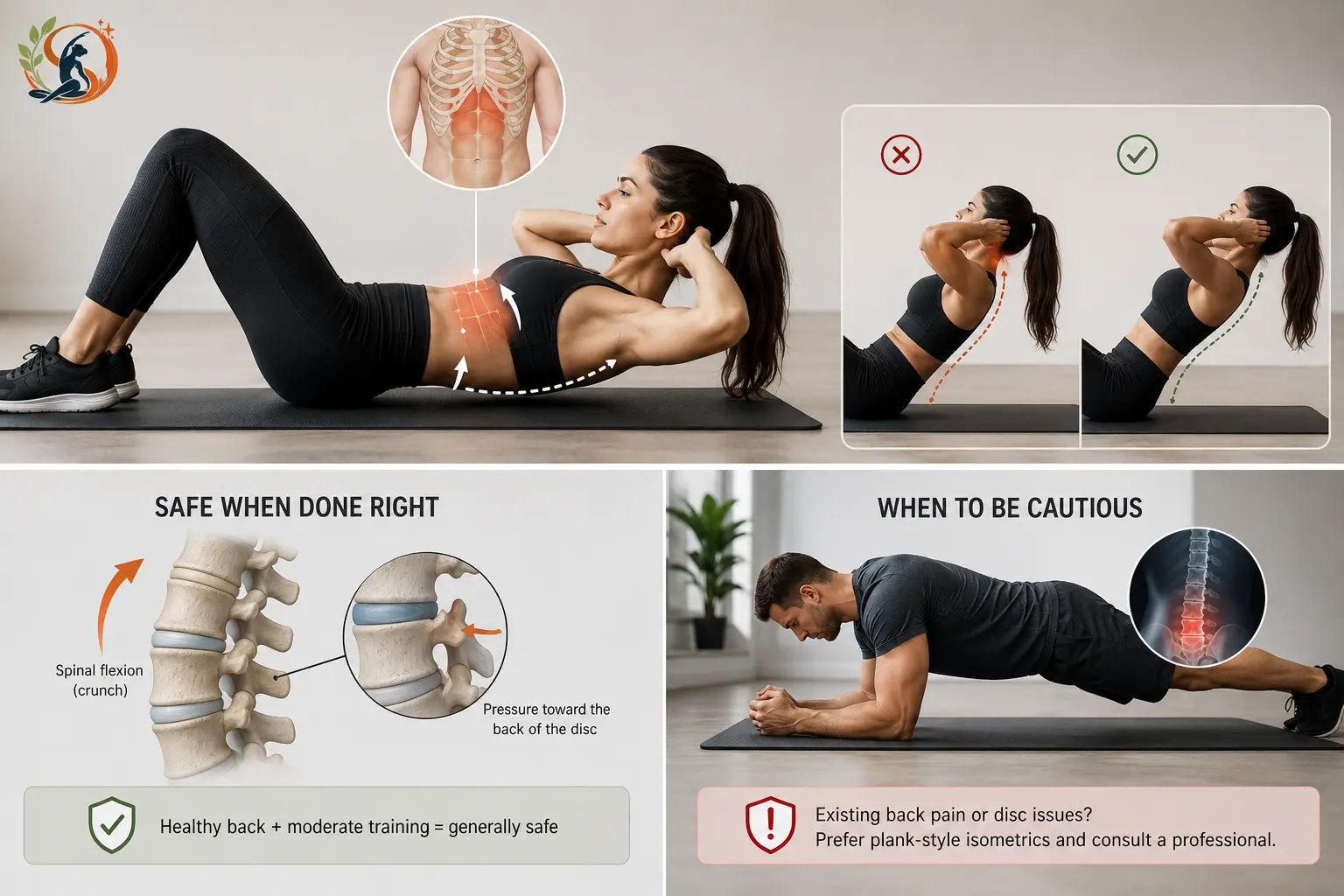
Spinal Flexion: The Movement That Actually Works
The upper abs' entire job is spinal flexion, curling your ribcage toward your pelvis. Think about lifting your sternum rather than yanking your chin toward your chest, which is the single most common mistake I see and the fastest route to a sore neck instead of sore abs. Keep your lower back pressed down, initiate from your upper spine and pause for a beat right where the contraction peaks at the top of each rep.
Is Spinal Flexion Safe for Your Back
This is a genuine, ongoing debate in the strength world, not just internet noise. Some coaches worry that repeatedly bending the spine under load can, over years, contribute to disc issues, since the motion pushes pressure toward the back of each vertebral disc. Other researchers, including some of the most cited names in muscle-growth science, push back hard on that concern, arguing spinal flexion work is safe and honestly necessary for full rectus abdominis development in anyone without an existing back problem.
Most coaches land somewhere in the middle. Healthy back, moderate crunch-style training is fine. Existing lower-back pain or disc issues, lean toward plank-style isometric work instead and check with a doctor or physical therapist before loading spinal flexion.
Warming Up Before an Upper Abs Workout
Cold abs and a straight-into-crunches approach don't mix well. A few minutes of core-specific mobility work goes a long way. Bird dogs, hands and knees on the floor, extending opposite arm and leg while keeping your core braced and back flat, wake up your deep stabilizers without any real load. Prone cobras, lying face down and pressing your torso up off the floor, gently counter all the spinal flexion you're about to do. A few rounds of each, ten to twelve reps, takes maybe three minutes and makes the actual workout feel noticeably more controlled.
How to Train Upper Abs the Right Way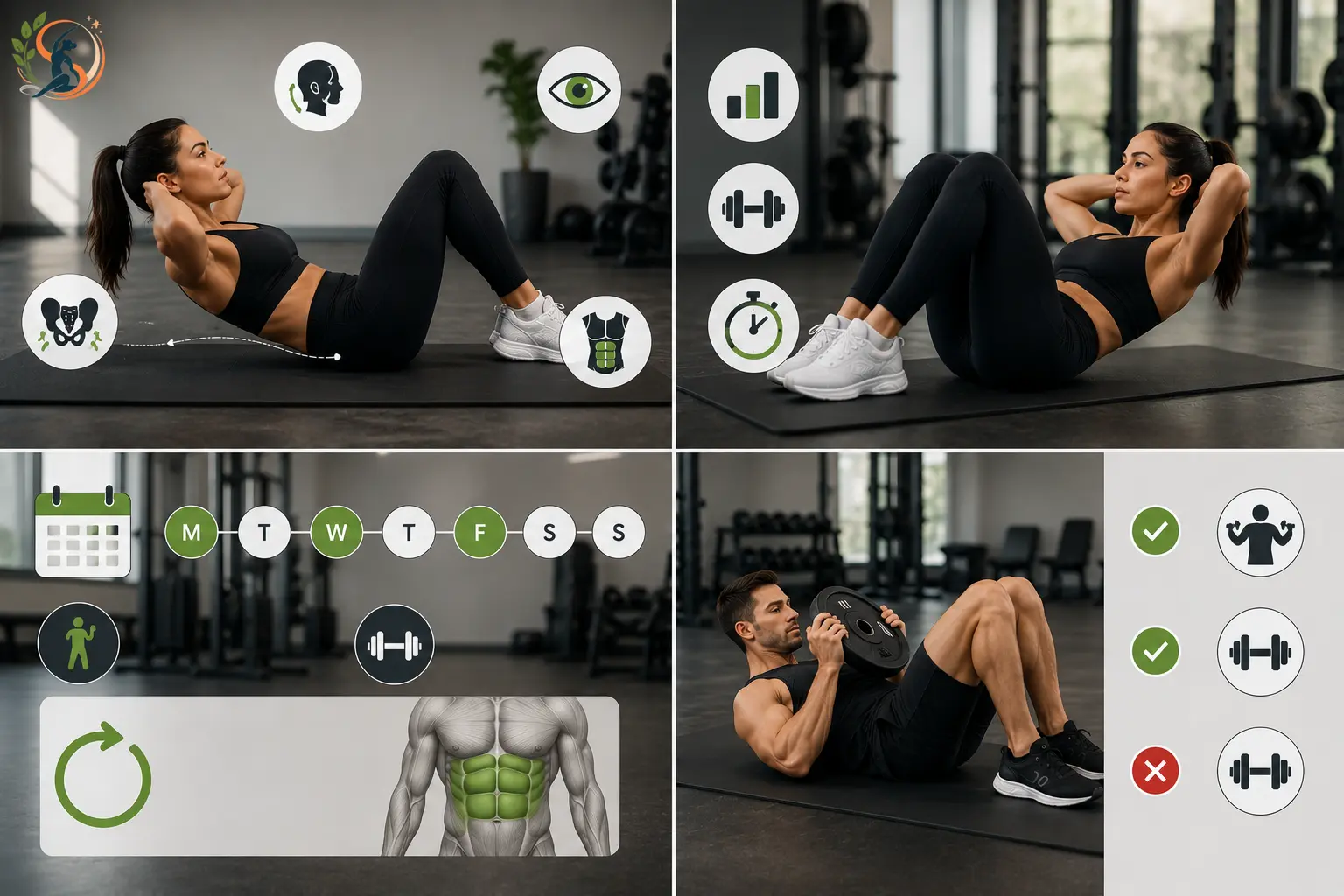
Form Cues That Actually Matter
Tuck your tailbone slightly before you even start moving. This switches off some of the hip flexor contribution and forces your abs to do more of the real work. Keep your chin gently tucked, not jammed into your chest and picture your eyes staying fixed on a spot on the ceiling instead of glancing down toward your knees. Feeling a rep more in your hip flexors than your abs? That's your hips compensating for weak core engagement. Slow down and refocus on the curl itself.
Sets, Reps and Tempo for Upper Abs
Most research and coaching consensus lands in the same place. 2 to 4 sets of 8 to 15 reps per exercise. Slow the lowering phase down, a 3-1-1 tempo works well, three seconds down, one second pause, one second up, since that eccentric portion is where a lot of the real strength and definition gains happen. Breezing past 15 clean reps without feeling much? Add resistance or change the angle instead of just cranking out more reps for the sake of it.
How Often and When in Your Week to Train Upper Abs
One to three focused sessions a week covers most goals. Abs are mostly endurance-postural muscles, they recover faster than something like your quads or back, so light bodyweight core work most days is generally fine. Heavier, loaded upper ab work, weighted crunches, cable work, decline work, needs closer to 48 hours between sessions, same as any other muscle group under real load. Placement in your week matters too.
Tacking ab work onto the end of an upper-body session works well, since your torso's already warm. If you're building out a full upper body dumbbell workout, this is a natural finisher. Just avoid stacking heavy weighted crunches on the same day as heavy squats or deadlifts, since both hammer your anterior core and the combination adds up to more fatigue than most people expect.
Best Upper Abs Exercises (Beginner to Advanced)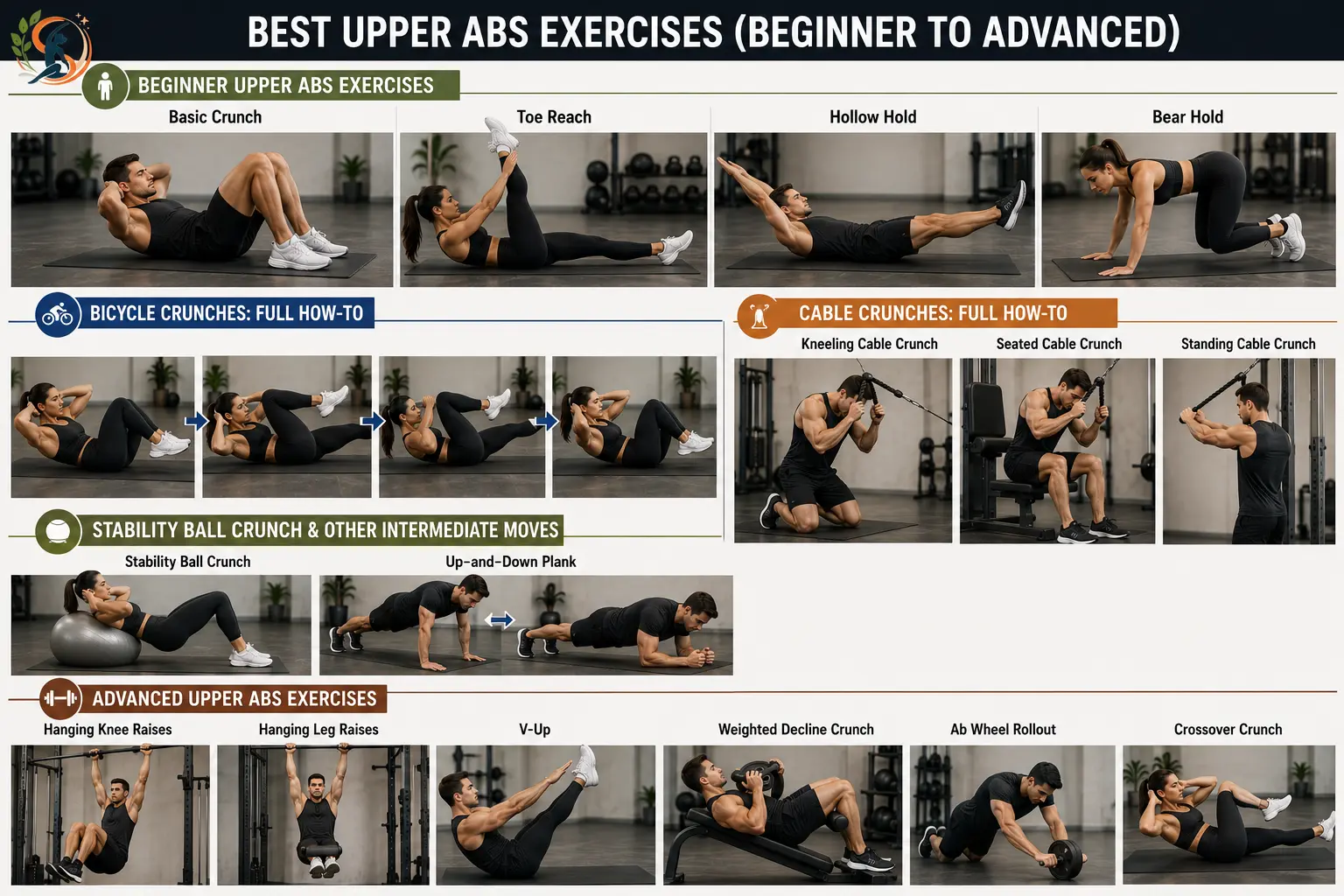
Beginner Upper Abs Exercises
The basic crunch is still the entry point for good reason. Lie on your back, knees bent, feet flat. Hands lightly behind your head or crossed over your chest, never laced tightly, that pulls on your neck. Curl your shoulder blades a few inches off the floor by bringing your ribcage toward your pelvis, pause, lower slowly. A toe reach works similarly with legs extended straight up, reaching your fingers toward your toes as you curl.
A hollow hold, lying flat with arms and legs extended and your lower back pressed firmly into the floor, trains the same muscles isometrically and is genuinely underrated as a beginner move. The bear hold, hovering on hands and knees with your knees just off the ground, is a fantastic low-impact way to wake up your whole core before you even get into crunching movements.
Bicycle Crunches: Full How-To
Bicycle crunches deserve their own breakdown, since they're one of the most searched upper ab moves out there and for good reason, they hit the rectus abdominis and your obliques together in one dynamic motion. Lie on your back, knees bent, feet off the floor, hands lightly behind your head. Flatten your lower back into the floor and bring your left elbow toward your right knee while extending your left leg straight out.
Return to center and switch sides in one continuous pedaling motion. Aim for slow, controlled reps rather than speed, rushing bicycle crunches is the fastest way to turn them into a hip-flexor exercise instead of an ab one. Three sets of 20 to 30 seconds per side works well for most people.
Cable Crunches: Full How-To
Cable crunches, sometimes called kneeling cable crunches or rope crunches, are arguably the best tool available for progressively overloading your upper abs, since you can add weight incrementally the same way you would with any other exercise. Attach a rope to the highest pulley on a cable station. Kneel a foot or two in front of the stack, grab both ends of the rope, bring your hands to the sides of your head with elbows pointing down, not flared out.
Exhale as you curl your spine down, bringing your ribs toward your pelvis and your elbows toward your thighs, hips staying still the entire time so the movement comes purely from your spine. Pause at full contraction, rise slowly. A seated cable crunch on a lat pulldown machine works the same way but keeps your hips naturally more stable if kneeling bothers your knees.
A standing cable crunch, facing away from the stack with the handle at forehead height, is a solid variation for anyone without knee-friendly flooring nearby. All three respond well to the same 2 to 4 sets of 8 to 15 rep range.
Stability Ball Crunch and Other Intermediate Moves
A stability ball crunch adds a genuine edge over the floor version. Sit on the ball, walk your feet out until your lower back rests on the curve, knees bent around 90 degrees. Crunch up while keeping your hips still so the ball doesn't roll out from under you. The ball's curve lets your spine move through a bigger range of motion than the floor allows, letting you access a deeper stretch at the bottom and a harder squeeze at the top.
Research comparing floor crunches to stability ball crunches has consistently found higher muscle activation on the ball, which makes it a smart mid-level progression once basic crunches feel too easy. An up-and-down plank, moving from a full plank to a forearm plank one arm at a time, adds real upper ab and shoulder work into what's normally a pure isometric hold.
Advanced Upper Abs Exercises
Hanging knee raises and eventually hanging leg raises with straight legs, demand real grip and core strength, hanging from a bar and curling your hips up rather than just swinging your legs for momentum. A V-up takes this further on the ground, lying flat and lifting your upper body and straight legs simultaneously until your body folds into a V shape, reaching your hands toward your toes at the top.
A weighted decline crunch, holding a plate across your chest on a decline bench, adds real resistance to a familiar movement. An ab wheel rollout trains the upper abs alongside serious deep core stability, though it takes real practice to load safely. A crossover crunch, reaching one straight leg across your body while crunching toward it, brings your obliques into the mix alongside your upper rectus.
Upper Abs Exercises for Female Training Goals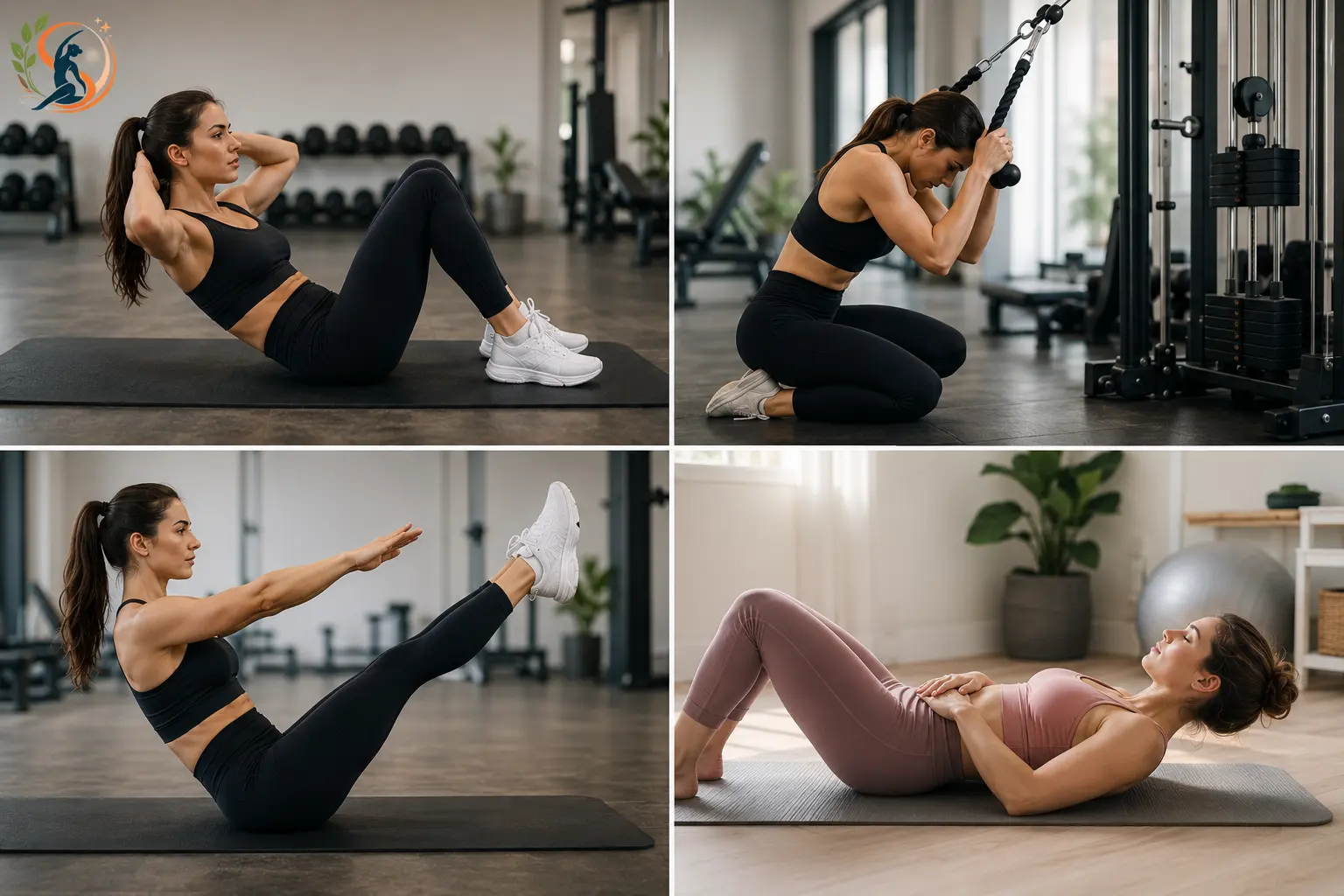
Do Women Need a Different Upper Abs Workout
Not structurally, no. The rectus abdominis works identically regardless of sex and every exercise above trains it the same way for anyone doing it. What tends to differ is starting load and rep range preference. Many women training for tone and definition lean toward higher rep ranges, 12 to 15, with lighter added resistance, while others chase the same strength-focused lower rep ranges as anyone else. There's no separate "female version" of a bicycle crunch. There's just your own starting point and your own goal.
Postpartum and Core Safety Considerations
This is a real gap most upper abs articles skip entirely. If you're postpartum, especially within the first several months, check for diastasis recti, a separation of the abdominal muscles along the midline, before jumping into crunch-style training. A physical therapist or doctor can assess this in a few minutes. Training through an unaddressed separation can genuinely make it worse instead of better. Once cleared, gentle core reconnection work, modified breathing exercises and pelvic tilts, usually comes before any real crunch or cable work resumes.
Sample Upper Abs Workouts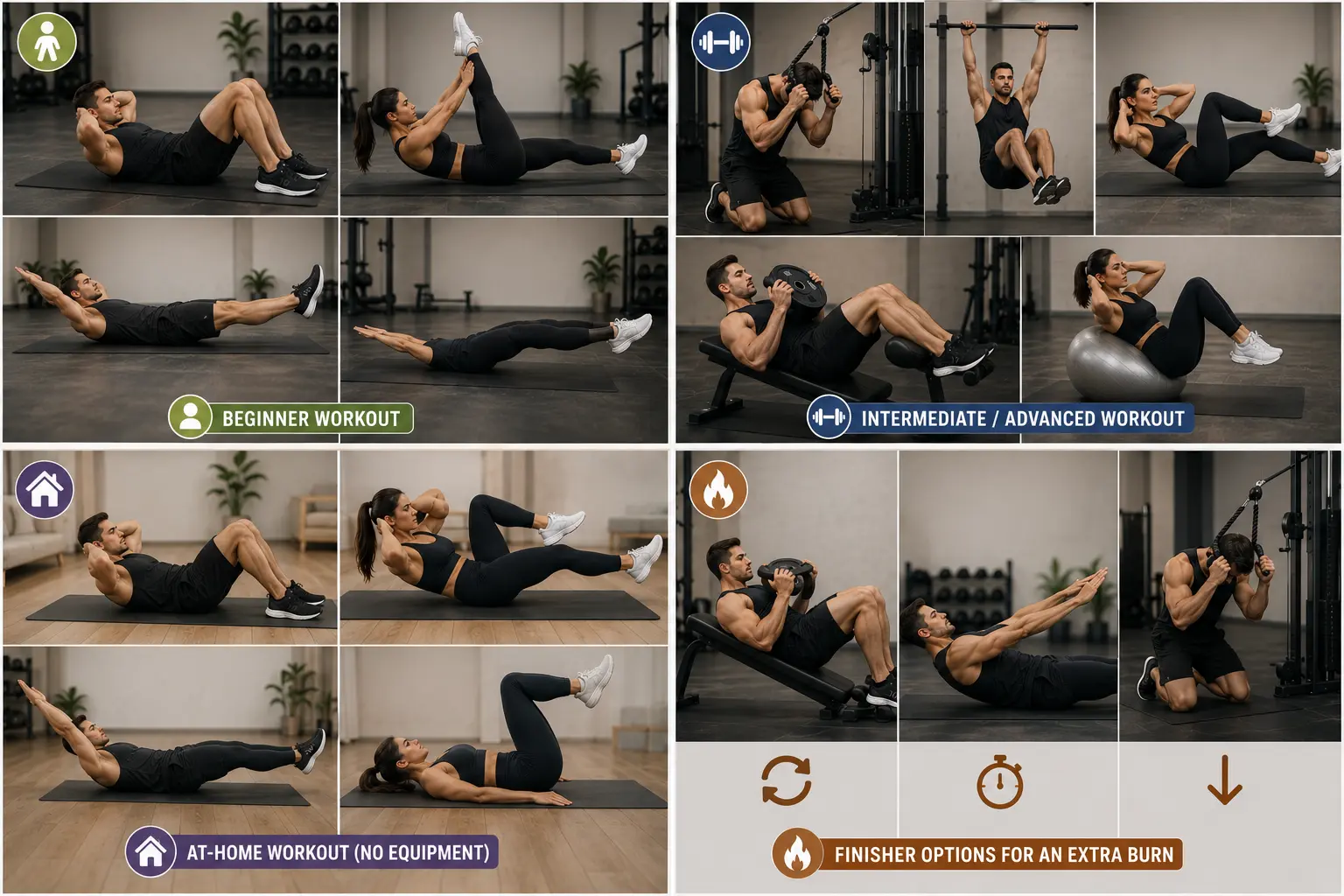
Beginner Upper Abs Workout
Crunch, 3 sets of 12 to 15. Toe reaches 3 sets of 12 to 15. Hollow hold, 3 sets of 20 to 30 seconds. Rest 30 to 45 seconds between sets. Once this feels genuinely easy with clean form, progress to a decline angle or add light resistance.
Intermediate/Advanced Upper Abs Workout
Cable crunch, 3 to 4 sets of 8 to 12. Hanging knee raise, 3 sets of 8 to 12. Bicycle crunches, 3 sets of 20 to 30 seconds per side. Weighted decline crunch, 3 sets of 10 to 15. Stability ball crunch, 3 sets of 12 to 15. Rest 45 to 60 seconds between sets. This one uses a bigger range of motion and real external load, expect it to feel noticeably harder than the beginner version even at similar rep counts.
At-Home Upper Abs Workout (No Equipment)
Crunch, 3 sets of 15. Bicycle crunches, 3 sets of 20 to 30 seconds per side. Hollow hold, 3 sets of 20 to 30 seconds. Reverse crunch, 3 sets of 12, to balance the upper-bias work with some lower-ab and full-core engagement in the same session. No equipment beyond a mat and the whole thing takes about 15 minutes.
Finisher Options for an Extra Burn
Want to end a session with something that actually hurts a little? Try a superset, weighted decline crunches taken to technical failure, immediately followed by a 30-second hollow hold with no rest between them. Or run a one-minute density set, as many clean toe reaches as possible in sixty seconds, lower back pressed the whole time. A drop set works too, cable crunches for 8 to 10 reps, drop the weight by around 30%, immediately knock out another 8 to 10 with strict form. Any one of these makes a solid once-a-week addition, not something to run every session.
Why Your Upper Abs Might Not Be Showing
The Real Body Fat Numbers for Visible Abs
Here's the part that stops most people cold and it's rarely stated this plainly anywhere. Most men need to reach roughly 8 to 12% body fat before real ab definition becomes visible. For women, that range sits closer to 14 to 18%, since women naturally carry more essential fat. You can have genuinely strong, well-developed upper abs underneath and still not see them at a higher body fat percentage and that's not a training failure. It's a nutrition and fat-loss issue, entirely separate from how hard you're training your core.
Spot Reduction Is a Myth (Here's the Proof)
You cannot out-crunch a bad diet and this isn't just conventional wisdom, it's been tested directly. A study looking at six weeks of dedicated abdominal training found real improvements in ab strength and endurance, but no measurable reduction in abdominal fat specifically. Fat loss happens across your whole body based on genetics and a calorie deficit, not from targeting one area with extra reps.
If visible abs are the actual goal, a sustainable calorie deficit, enough protein and consistent strength training across your whole body will get you there faster than any amount of extra crunches ever will.
Will Training Your Abs Make Your Waist Bigger
Short answer, no, not meaningfully. The rectus abdominis can hypertrophy like any muscle, but that growth is small compared to something like your quads or glutes. A stronger, more developed core tends to make your midsection look tighter once body fat comes down, not wider. If your waist feels bigger right after a hard ab session, that's usually temporary inflammation or water retention from the workout itself, not permanent muscle growth changing your shape overnight.
Frequently Asked Questions
1. What exercise is best for upper abs?
Cable crunches are generally considered the best single exercise, since they let you progressively add resistance the same way you would with any other strength move. Bicycle crunches and weighted decline crunches are close runners-up for building real upper ab strength and definition.
2. How can I tighten my upper stomach?
Combine spinal-flexion exercises like crunches and cable crunches with a consistent calorie deficit and adequate protein intake. Training builds and tightens the muscle itself, but visible tightening also depends on reducing overall body fat through diet, since you cannot spot-reduce fat from one area alone.
3. Do crunches hit upper abs?
Yes, crunches are one of the most effective moves for biasing the upper rectus abdominis, since the motion directly curls your ribcage toward your pelvis. Research consistently shows crunch-style spinal flexion activates the upper abs more than lower-ab-focused movements like reverse crunches.
4. What are the top 3 best AB workouts?
Cable crunches, bicycle crunches and hanging knee raises consistently rank among the most effective upper ab exercises. Together they cover progressive loading, dynamic oblique engagement and hip-to-rib flexion, giving you well-rounded coverage across the entire rectus abdominis.
5. Is it bad to do crunches every day?
Light, bodyweight crunches most days are generally fine, since abs recover quickly compared to larger muscle groups. Heavier, weighted upper ab work like loaded cable crunches or decline crunches needs about 48 hours of recovery between sessions, the same as training any other muscle under real load.
6. Will training my abs make my waist bigger?
No, not meaningfully. The rectus abdominis grows very little compared to larger muscle groups like the quads or glutes. A stronger core usually makes your midsection look tighter once body fat drops and any temporary size increase after a workout is just inflammation or water retention.
Conclusion
A real upper abs workout isn't about chasing one miracle exercise or grinding through endless reps every single day. It's spinal flexion done with intent, cable crunches and bicycle crunches loaded and progressed the same way you'd train any other muscle and enough patience with your nutrition to actually let the definition show once it's built. The training side is honestly the easier half of this whole equation.
Start with the beginner routine above, add resistance once it stops challenging you and remember the mirror follows your diet just as much as your workout. New to structured gym training altogether? Our gym exercises for beginners guide is a good place to build the foundation this routine sits on top of.


Comments (0)
No comments yet. Be the first to share your thoughts!
Leave a Comment