
I've sat across the table from a lot of nervous candidates over the years. I've also been that nervous candidate myself, more times than I care to admit out loud. The hands go a little cold. The mind starts racing through worst case scenarios that will almost certainly never happen and yet somehow they feel completely real at 8am on interview day.
And then, of course, every answer you rehearsed perfectly in the mirror that morning just disappears the second you sit down across from a stranger holding a clipboard. Classic. This is exactly where meditation for interview prep earns its place and honestly? It works far better than most people expect, right up until they actually give it a real try.
This guide walks through how meditation interview techniques and a simple journaling habit can settle your nerves before, during and after the big day. I'll also touch on a few genuine interview basics along the way, because a calm mind only gets you so far without solid preparation sitting underneath it.
Why Meditation for Interview Prep Helps
There's a reason this combination keeps popping up in career advice lately and it's not just some wellness trend dressed up in corporate language to sound professional.
What Happens to Your Body Before an Interview
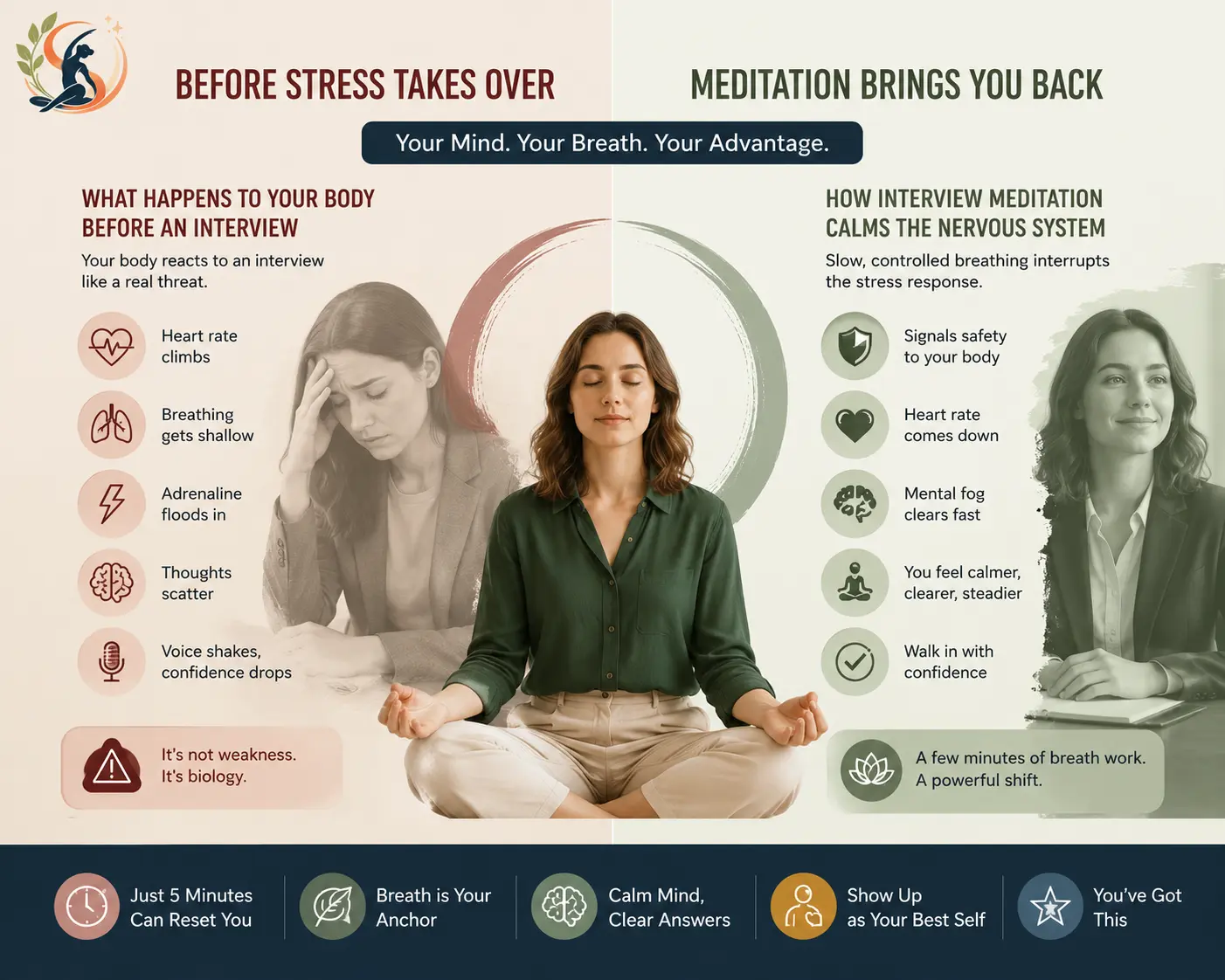
Your body genuinely doesn't know the difference between a job interview and an actual threat standing in front of you. The nervous system floods with adrenaline, your heart rate climbs, your breathing gets shallow, the exact same response you'd get from a real emergency. Not a metaphorical one. An actual, run for your life, kind of response.
That's why your voice sometimes shakes or your thoughts scatter right when you need them most, right when it matters. It's not weakness. It never was. It's just biology doing what biology has always done, whether we like the timing or not and let's be honest, the timing is always terrible.
How Interview Meditation Calms the Nervous System
Interview meditation works by directly interrupting that stress response before it takes over completely. A few minutes of slow, controlled breathing signals to your body that you're actually safe, which brings your heart rate back down and clears the mental fog fast, faster than most people expect, myself included the first time I tried it.
I've watched candidates go from visibly shaking to noticeably steady in under five minutes, using nothing more than breath work before walking into a room. Sounds almost too simple to work, I know. But the science behind it holds up surprisingly well and so does the anecdotal evidence, at least from where I've been standing.
Building a Morning Journaling Routine Before Interview Day
Meditation handles the body. Journaling handles the mind. And honestly, most people skip this second part entirely, which is kind of a shame, because it's arguably the easier half of the two.
Reflective Writing Technique to Clear Your Head
A short reflective writing technique the morning of an interview does wonders for mental clutter, way more than people give it credit for. Spend five minutes writing down whatever's bouncing around your head, worries, hopes, random thoughts about traffic or what shirt to wear, it doesn't matter, just get it out.
Getting it onto paper takes it out of your head, which frees up mental space for the actual conversation waiting ahead of you. I do this before almost anything stressful now, not just interviews and honestly it's become one of those habits I genuinely can't skip anymore. I tried skipping it once before a big meeting. I regretted it almost immediately.
Gratitude Journal Practice to Shift Your Mindset
A quick gratitude journal practice shifts your mindset from anxious to grounded faster than you'd think possible. Write down three things you're genuinely thankful for that morning. Nothing fancy required, even something as small as good coffee counts fully, no judgment here.
This small habit pulls your focus away from fear and toward something steadier underneath it, which changes how you carry yourself the moment you walk through that door.
Mindfulness Journaling Prompts for Interview Nerves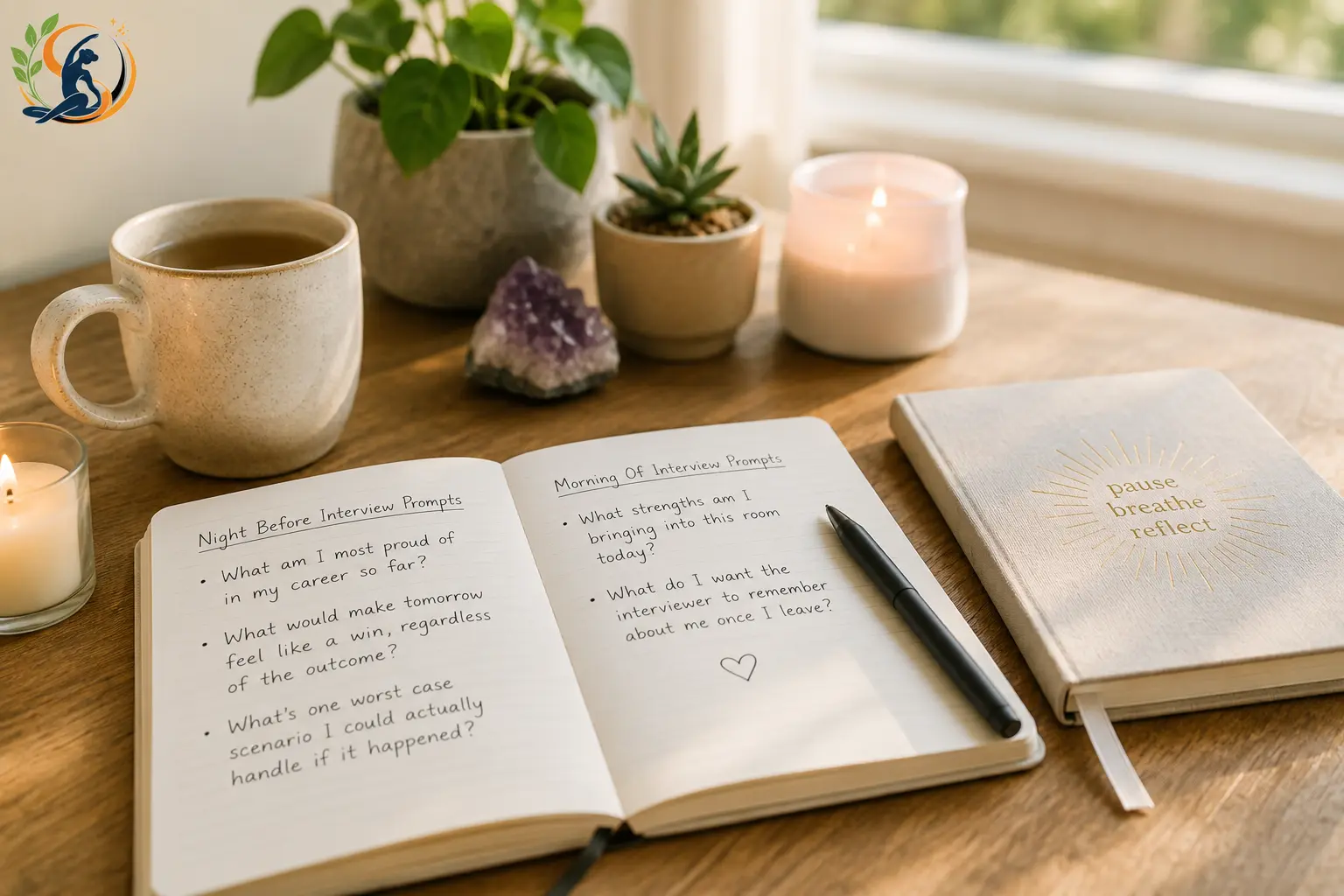
If a blank page feels intimidating and it often does, a few mindfulness journaling prompts make the whole thing much easier to actually start.
Prompts for the Night Before
The night before, try writing answers to prompts like these. What am I most proud of in my career so far? What would make tomorrow feel like a win, regardless of the final outcome either way? What's one worst case scenario I could actually handle if it happened?
Writing through these questions takes the fear out of the unknown, which is usually exactly where most interview anxiety lives in the first place. Not in the interview itself. In the not knowing.
Prompts for the Morning Of
In the morning itself, keep things lighter and shorter than the night before, you don't need a full essay. What strengths am I bringing into this room today? What do I want the interviewer to remember about me once I leave? A few honest sentences here, written before you even get dressed, sets a steadier tone for everything that follows.
Does Journaling Count as Meditation
This question comes up constantly, so let me just answer it directly instead of dancing around it. Journaling can absolutely function as a form of meditation, specifically what a lot of people call written mindfulness these days.
The act of slowing down, focusing fully on your thoughts and putting them into actual words mirrors the same present moment awareness traditional meditation builds over time. It's not identical to sitting in silence with your eyes closed, I'll give you that. But the underlying mental shift? Remarkably similar. Closer than most people assume, honestly.
How Journaling and Meditation Work Together
Meditation and journaling actually complement each other rather than compete for the same headspace. Meditation quiets the noise first. Journaling then gives that quiet mind something structured to explore once the noise has actually settled down.
I usually recommend five minutes of meditation followed immediately by five minutes of writing, since the clarity from meditation tends to produce sharper, more honest journal entries right after. Almost every single time I try it in that order.
Written Mindfulness and Emotional Processing Through Writing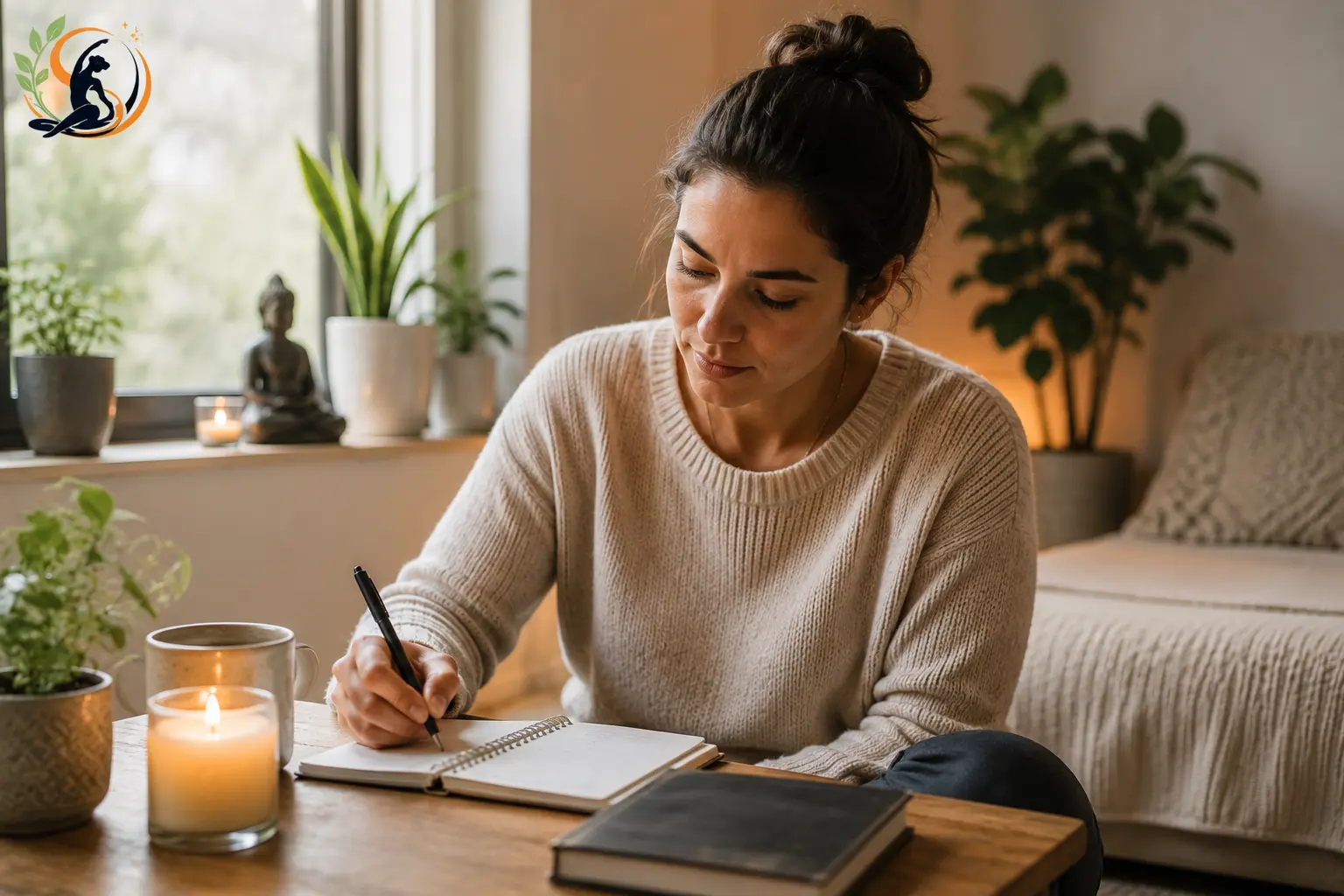
Emotional processing through writing gives anxious feelings somewhere to actually go instead of just circling endlessly in your head all morning. Interview nerves often come from unspoken fears sitting underneath the surface, fear of judgment, fear of freezing up mid sentence, fear of simply not being enough for the role. Name that fear.
Naming these fears on paper, in plain, honest language, tends to shrink them down to something far more manageable than they felt while they were still just noise rattling around in your mind, unnamed and somehow bigger for it. Loving kindness meditation is worth trying too, especially if interview nerves are tangled up with harsher self-talk.
A Simple Meditation Interview Routine You Can Use Today
Here's an actual routine you can run through, start to finish, before your very next interview. For a longer daily practice beyond interview prep specifically, this guided meditation script for beginners is a good next step.
Five Minute Breathing Practice
Sit somewhere quiet, close your eyes if that feels comfortable and breathe in for four counts, hold for four, then exhale for six full counts. Repeat for five full minutes, no more, no less. The extended exhale specifically tells your nervous system to relax, which is exactly what you need right before walking into a high pressure room full of strangers judging your every answer.
Grounding Technique Before You Walk In
Right before you enter the building, try a quick grounding technique that only takes a minute. Notice five things you can see, four things you can hear, three things you can physically feel, like your feet on the ground or your hands resting in your lap. This pulls your mind fully into the present moment, away from spiraling thoughts about everything that might go wrong in the next thirty minutes. It won't. Probably.
What Did Jesus Say About Meditating?
This question comes up more often than you'd expect, so it deserves a brief mention here. Several passages in the Bible reference meditating on scripture, with Joshua 1:8 and Psalm 1:2 among the most commonly cited, both encouraging quiet reflection on written words day and night, without pause.
While this isn't directly about interview preparation, obviously, it does show that meditative practice, in one form or another, has roots stretching back thousands of years across a lot of different traditions and beliefs. Longer than most of us realize.
Bonus: Quick Interview Basics Worth Knowing
A calm mind matters, sure. But real preparation still carries serious weight too, so here are a few basics worth keeping in your back pocket.
The 30-60-90 Rule in an Interview
The 30-60-90 rule usually refers to a plan showing what you intend to accomplish in your first 30, 60 and 90 days on the job, laid out in clear stages. Bringing a simple version of this into an interview, especially for management roles, shows employers you've already thought seriously about how you'd actually approach the position from day one.
The 5 C's of Interviewing
The 5 C's of interviewing generally cover competence, character, communication, culture fit and career direction. Interviewers are quietly evaluating all five throughout the entire conversation, even when the actual questions don't obviously point toward them, so keeping these in mind helps you shape more well rounded, complete answers.
The Biggest Red Flag Interviewers Notice
The biggest red flag most interviewers mention, without fail, is speaking negatively about a previous employer or manager. It signals poor judgment and raises real doubts about how you might talk about their company down the road, once you've moved on to greener pastures.
Staying professional and measured, even when discussing a genuinely bad past experience, protects your credibility every single time you sit down across from someone new.
Frequently Asked Questions
1. How do journaling and meditation work together?
Meditation calms your mind first, creating mental space, while journaling gives that calm mind somewhere structured to process thoughts. Practicing them together, meditation followed by a short writing session, tends to produce clearer thinking and steadier emotions than using either practice completely on its own.
2. What should I write in a mindfulness journal?
Write down current thoughts, feelings and physical sensations without judging them. Include what you're grateful for, what's worrying you and one small intention for the day ahead. There's no wrong way to do this, since the goal is honest reflection, not polished writing.
3. Does journaling count as meditation?
Yes, journaling can function as a meditative practice, often called written mindfulness. It builds present moment awareness and focused attention, much like traditional meditation does. While it looks different from sitting quietly with closed eyes, the underlying mental benefits overlap significantly between both practices.
4. What is the 30-60-90 rule in an interview?
It refers to a plan outlining specific goals for your first 30, 60 and 90 days in a new role. Presenting this during an interview, particularly for leadership positions, demonstrates preparation and shows the employer you've already thought through your approach to the job.
5. What is the biggest red flag to hear when being interviewed?
Speaking negatively about a former employer or manager is widely considered the biggest red flag interviewers notice. It suggests poor professional judgment and raises concern about how a candidate might discuss the new company later. Staying diplomatic, even about rough past experiences, protects your credibility.
6. What are the 5 C's of interviewing?
The 5 C's typically stand for competence, character, communication, culture fit and career direction. Interviewers assess all five throughout the conversation, often without stating it directly, so preparing answers that naturally reflect these areas helps you present a more complete, well rounded impression.
Conclusion
Interviews will probably always come with some nerves attached and honestly, I don't think that's entirely a bad thing. It usually means you actually care about the outcome, which counts for something in a world where plenty of people don't. But meditation for interview prep, paired with a few honest minutes of journaling beforehand, takes the edge off just enough that your real preparation and experience can finally shine through, instead of getting buried under pure panic the second you sit down.
Try the breathing practice on the morning of your next interview. Jot down a few honest journal prompts the night before, even if it feels a little silly at first, it usually does at first. Walk in already a little steadier than you would've been otherwise. That steadiness tends to show more than people realize and interviewers notice it almost every time.


Comments (0)
No comments yet. Be the first to share your thoughts!
Leave a Comment